

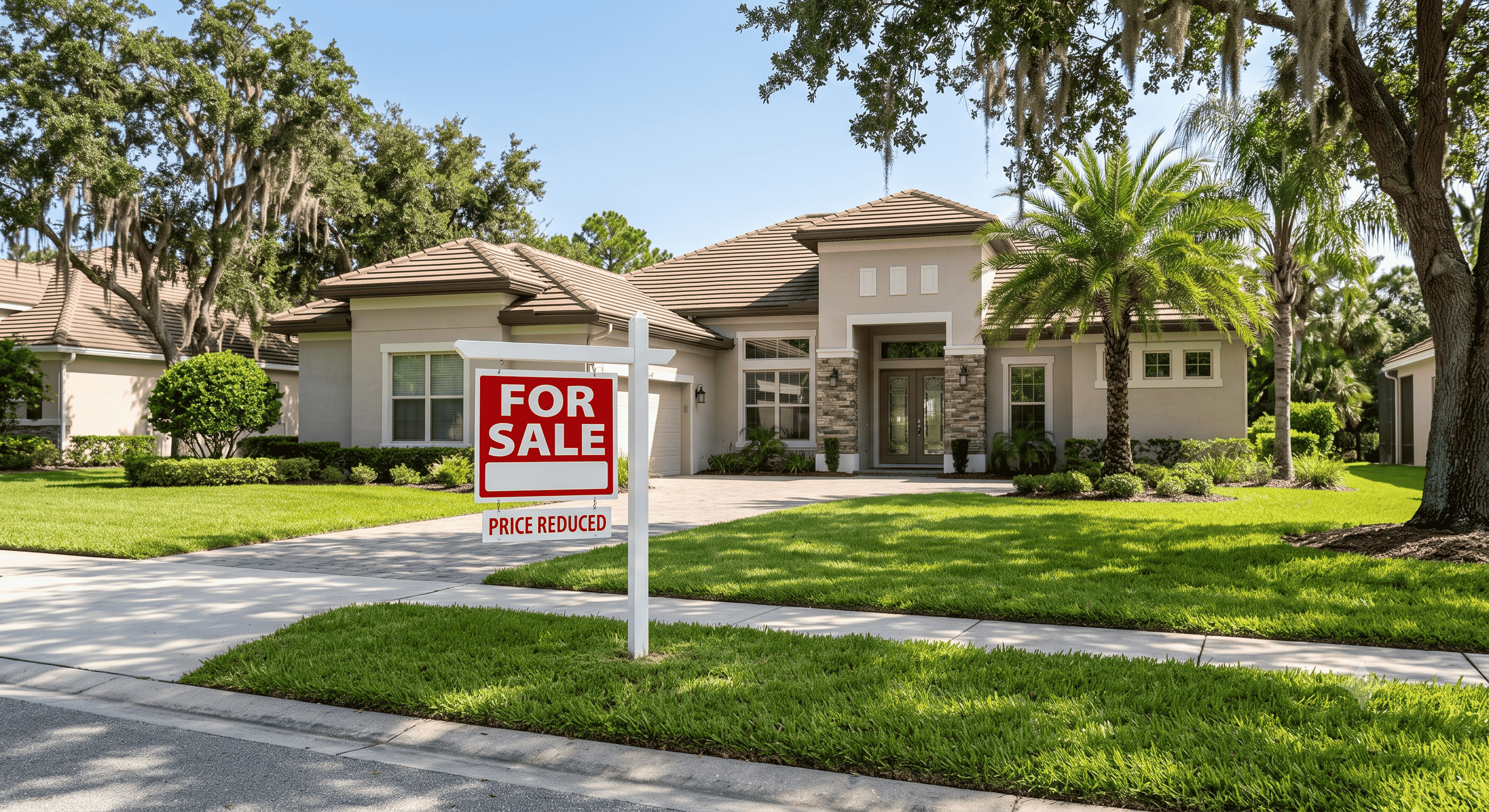
Seeing a flood of "Price Reduced" badges across Orlando listings in July can feel unsettling, especially if you've been watching the market closely. Your first instinct might be that something is wrong, that prices are collapsing, or that buyers who jumped in earlier made a terrible mistake. The reality is far less dramatic and actually more useful to understand.
Price cuts in Greater Orlando right now are not a sign of a market in freefall. They reflect a market that is finally breathing again after years of being artificially compressed by low inventory and frenzied competition. Orange County real estate is shifting toward balance, and that shift is creating real opportunities for buyers who know what they're looking at and sellers who are willing to adjust their expectations.
The core idea worth holding onto is this: a "Price Reduced" tag is a negotiating signal, not a distress signal. The best opportunity in this market is often not a lower sticker price alone, but better deal terms that make a home genuinely more affordable month to month. That includes things like seller-paid rate buy-downs, closing cost credits, and inspection concessions that can change what you actually pay over time.
This article walks through what July price cuts really mean in the Orlando market, how to spot listings with the most negotiating room, what the numbers look like across Orange County and specific zip codes like 32806 and 32812, and what both buyers and sellers should do with this information.
What July Price Cuts Really Mean for Orlando Buyers Right Now
Most buyers see a price reduction and wonder whether it means the market is turning against sellers. What it usually means is simpler: the home was priced too high for where the market actually is, and the seller is catching up to that reality.
Orlando is moving toward a balanced market, with supply levels pushing toward roughly 4.5 to 5 months. That's a significant shift from the sub-two-month inventory levels that defined the pandemic years. Homes are also taking longer to sell, with city-level data showing averages in the 40 to 50 day range, and broader market reports placing that number even higher in some segments. When a home sits longer than expected, a price cut is often the seller's first response.
That response tells you something important. It means the seller launched the listing with expectations that no longer match buyer behavior. Maybe they priced based on a sale from eight months ago, or they assumed the market was still moving as fast as it was in 2022. Either way, the reduction is less about the home losing value and more about the seller recalibrating.
For buyers, this is genuinely good news. A listing that has already taken one price cut and is still sitting is a listing where the seller's confidence has shifted. They've already acknowledged the market isn't giving them what they wanted. That acknowledgment opens a door.
Stale listings, meaning homes that have been on the market for 45 days or more without goi
ng under contract, are where some of the best leverage in the current Orlando market lives. These are not problem homes by default. Many are perfectly solid properties that were simply overpriced at launch or listed during a slow showing period. The seller's patience has a limit, and the longer a home sits, the more that limit matters in a negotiation.
Why a Stale Listing Can Save You More Than a Small Price Cut
The real win on a 45-plus day listing is rarely the price reduction itself. It's what comes after, when a seller who has been watching their home sit decides they're willing to do more than just drop the number.
Seller fatigue is a real phenomenon. After weeks of showings that lead nowhere, or worse, no showings at all, sellers become far more open to concessions that they would have rejected outright in the first week. That's where buyers can achieve something more valuable than a discount on the purchase price.
A permanent interest rate buy-down, for example, is a concession where the seller contributes money at closing to reduce your mortgage rate for the life of the loan. On a $400,000 home, buying down the rate by even half a point can save tens of thousands of dollars over 30 years. Compare that to asking for a $5,000 price reduction, which lowers your monthly payment by roughly $25 to $30. The buy-down wins by a wide margin.
Closing cost credits work similarly. Instead of lowering the price, the seller covers a portion of what you'd normally pay out of pocket at closing. That directly reduces how much cash you need to bring to the table, which matters enormously for buyers who are stretching to make a purchase work. Repair credits, negotiated after inspection, add another layer. A seller who has been sitting on a listing for two months is far less likely to push back on a repair request than one who received three offers in the first weekend.
Thinking in terms of payment strategy rather than headline discount is what separates buyers who get good deals from buyers who get great ones. A home priced at $415,000 with a seller-paid rate buy-down and $8,000 in closing cost credits is a better deal than the same home at $405,000 with no concessions, depending on your financing situation. Running those numbers with a lender before you make an offer changes how you approach the negotiation entirely.
Affordability-minded buyers in Orlando right now should be asking one question before anything else: what does this deal actually cost me per month, and what can the seller do to bring that number down? That question leads to better outcomes than fixating on getting the list price as low as possible.
How to Spot the Orlando Listings With the Most Negotiating Room
Days on market is the single most useful data point for identifying where seller flexibility is highest. It's not the only signal, but it's the most reliable starting point.
Here's a simple way to think about seller mindset based on how long a home has been listed:
- Fresh listings (0 to 14 days) are usually held by sellers who still believe in their price. Offers below asking are often rejected quickly, and concession requests may not land well. These sellers haven't felt market pressure yet.
- Testing the market (15 to 44 days) is where sellers start paying closer attention to feedback. If showings are happening but offers aren't coming, they're beginning to wonder whether the price is the problem. This range can produce negotiation opportunities, especially if you come in with a clean, well-structured offer.
- Fatigue zone (45 days and beyond) is where the real leverage tends to be. Sellers in this range have usually already had at least one price reduction, may have adjusted their timeline, and are increasingly motivated to make something happen. This is where buyers can ask for more and get more.
Beyond days on market, a few other signals are worth checking. Multiple price cuts on a single listing suggest the seller has been chasing the market downward, which usually means they're still open to moving further. Back-on-market history, where a home went under contract and then fell through, can indicate either buyer financing issues or inspection problems that the seller hasn't fully addressed. Weak showing activity, which your agent can sometimes gauge through listing feedback and agent networks, points to a home that isn't generating demand.
Nearby sold comps matter too. If similar homes in the same zip code sold for $30,000 less than the current asking price, that gap is your starting point for the conversation. One strategic price cut might mean the seller is being smart about positioning. Repeated cuts mean they're reacting, and reactive sellers are negotiable sellers.
Timing pressure on the seller's side can matter just as much as the home's price. A seller who has already purchased another home, or who is relocating for work, has a deadline that works in your favor. Asking your agent to find out about the seller's situation is a completely normal part of the process and can shape your entire offer strategy.
 What the Numbers Look Like in Orlando, Orange County, and Two Local Zip Codes
Grounding this in actual market data makes it easier to feel confident rather than anxious about what's happening. Across Greater Orlando, median home prices are sitting in the low $400,000s, inventory has expanded meaningfully compared to the frenzy years, and homes are taking longer to sell in nearly every segment. That combination describes a market that is more competitive for sellers and more navigable for buyers than anything we've seen since 2020.
Zip code 32806, which covers parts of the Conway and Hourglass District areas south of downtown Orlando, is one of the more desirable pockets in the metro. Homes here tend to hold their value better than in outlying areas because of proximity to employment, walkable neighborhoods, and strong school options. Even so, price cuts are showing up here. When a home in 32806 takes a reduction, it's usually a strategic adjustment rather than a sign of distress. The seller likely priced at the top of the range and is now meeting the market. Buyers in this zip code should expect less room on price but may still find concession opportunities on well-priced homes that have lingered.
Zip code 32812, covering areas like Conway and parts of Belle Isle, tells a slightly different story. Days on market tend to run longer here, and the buyer pool is somewhat more price-sensitive. That combination means sellers feel the pressure sooner, and listings that have been sitting for 45-plus days are more common. For buyers, 32812 offers clearer leverage because the market dynamics favor patience. Coming in with a thoughtful offer that asks for credits or a rate buy-down is a realistic strategy in this zip code right now.
The comparison between these two areas makes a broader point worth absorbing. A price cut in 32806 and a price cut in 32812 can mean very different things even though they're both inside the same metro. In 32806, a reduction might still leave the home priced competitively with limited room to negotiate further. In 32812, that same reduction might be the opening move in a negotiation that has more room to run. Reading the local context, not just the badge on the listing, is what leads to smarter decisions.
Real Examples That Show How Price Cuts Are Playing Out on the Ground
Across 32806, price reductions are showing up at multiple price points. Higher-end homes in the $550,000 to $650,000 range that launched in spring have seen cuts of $15,000 to $25,000 after sitting for six to eight weeks without offers. These aren't distressed properties. They're well-maintained homes that were priced for a faster market. The sellers aren't panicking, but they are adjusting, and that adjustment signals room for a conversation about terms.
Mid-range listings in 32806, priced between $380,000 and $450,000, are showing similar patterns. A home that launched at $429,000 and dropped to $415,000 after 40 days is a home where the seller has already moved once. That first move usually makes a second move, whether in price or concessions, easier to negotiate. Buyers who come in with a clear understanding of what nearby homes have actually sold for, not just what they're listed at, are in the strongest position.
In 32812, the picture is a bit more spread out across property types. Condos in the $200,000 to $280,000 range have seen some of the more notable reductions, partly because condo buyers are more sensitive to HOA fees and financing restrictions. A condo listed at $265,000 that drops to $249,000 after 50 days is one where the seller is feeling real pressure, and a buyer who asks for closing cost help on top of the reduced price may be surprised by how receptive the response is.
Family homes in 32812, typically in the $350,000 to $475,000 range, are also showing longer days on market and periodic reductions. Move-up buyers targeting this segment should pay attention to listings that have had two or more cuts. A home that started at $459,000, dropped to $445,000, and then to $432,000 over three months is a home where the seller's strategy hasn't worked and they know it. That's a meaningful negotiating position for a prepared buyer.
What these examples show collectively is that reductions aren't clustered in one price bracket or one type of seller. They're spread across condos, starter homes, and move-up properties. A small cut of $5,000 to $10,000 often signals a strategic repositioning. A larger cut of $20,000 or more, especially when combined with extended days on market, usually signals genuine flexibility that goes beyond the price itself.
What Buyers Should Do Next and What Sellers Should Not Panic About
Making a strong offer on a stale listing starts with knowing what you actually need from the deal. Before you settle on a number, talk to your lender and figure out which concession helps you most. If your cash reserves are tight, closing cost credits matter more than a price reduction. If your monthly payment is the bigger concern, a seller-paid rate buy-down deserves to be the centerpiece of your offer.
When you've identified a listing with 45-plus days on market, structure your offer to address the seller's likely frustration. A clean offer with a reasonable inspection period, a clear financing letter, and a specific concession request is more compelling than a lowball price with no explanation. Sellers who are fatigued want certainty as much as they want money. Giving them confidence that the deal will close is part of what makes your offer competitive even when it's asking for something in return.
Inspection findings are another area where stale listings give buyers room. A seller who has been waiting two months for an offer is far less likely to walk away over a $3,000 repair request than one who has backup offers. Use the inspection process to address real concerns, not as a second negotiation, but know that the leverage is there if the findings are legitimate.
Sellers navigating this market have a different set of decisions to make, but the core advice is straightforward. Pricing accurately from the start, based on what similar homes have actually sold for in the last 60 to 90 days, is the most effective way to avoid the cycle of reductions. A home that launches at the right price generates more showing activity and stronger offers than one that starts too high and chases the market down.
Slower traffic after a listing goes live is worth responding to with strategy rather than anxiety. Dropping the price reflexively can work against you if the reduction isn't significant enough to change buyer behavior. Sometimes a better response is improving the listing presentation, adjusting the showing schedule, or offering a specific incentive like a home warranty or rate buy-down credit that makes the home stand out without reducing the price further.
 Conclusion
July price cuts in Orlando are better understood as signs of normalization than evidence of a collapse. The market has more inventory, homes are taking longer to sell, and sellers who priced for a faster environment are adjusting. That adjustment is healthy, and it creates real opportunity for buyers who approach it with a clear strategy.
Listings that have been sitting for 45-plus days deserve serious attention. Seller fatigue in that range often translates into concessions that improve your monthly payment and reduce your cash to close far more than a modest price reduction would on its own.
Neighborhood context shapes how you read these signals. A price cut in 32806 carries different weight than one in 32812, even though both are happening across the Orlando metro. Understanding that difference helps you decide where to focus your energy and how aggressively to negotiate.
The best deals being made in Central Florida right now aren't going to the buyers who waited for prices to crash. They're going to the buyers who understood what the market was actually saying and made offers that reflected that understanding.
Check out this article next